Compassion and Solidarity by Gregory Baum
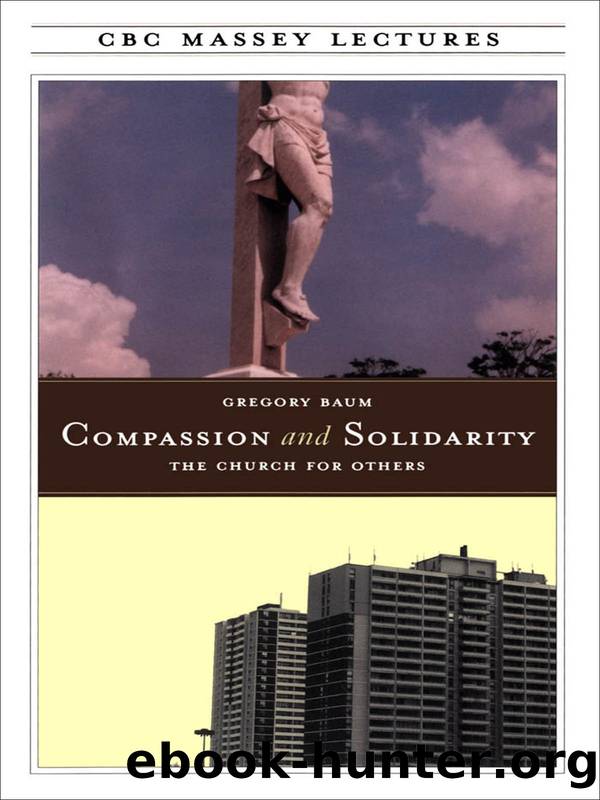
Author:Gregory Baum
Language: eng
Format: epub
Tags: FIC000000
Publisher: House of Anansi Press Inc.
Published: 1992-09-28T16:00:00+00:00
4. God as Comforter and Liberator
IN THESE LECTURES I HAVE BEEN DISCUSSING a new movement in the churches, one that binds Christian faith to the yearning for social justice. I have been maintaining that what has taken place is an explosion of compassion and solidarity, and this new movement has important spiritual implications. It has generated new principles of social ethics and summoned forth the Church’s involvement in the struggle for justice. But in addition, it has also created new forms of prayer and produced new theological reflections on the biblical God.
Let me begin this fourth lecture with the hopeful message, formulated by modern theology and endorsed by the Second Vatican Council in 1965, that God is graciously present in the whole of humanity. People wrestling with issues of truth and justice are not simply left to their own limited resources: they are deeply touched by a light and a strength not of their own making: the sign of God’s gracious presence.
According to this message, the redemption of Jesus Christ is an inclusive event. It touches the whole of the human family. Here is one of Vatican II’s famous sentences: “Since Christ died for all, and since the ultimate vocation of humans is one and divine, we ought to believe that the Holy Spirit, in a manner known only to God, offers to every human being the possibility of being associated with Christ’s redemption.”
This is the theology on the basis of which Vatican II opened the Church to the world, fostered dialogue with the world religions, and urged Catholics to cooperate with others, be they religious or secular, to build a more humane world. Cooperating with these others, Catholics would encounter God, God incarnate in humanity.
Not only were their actions affected; the emerging theology affected Catholics in their perception of God and hence their mode of prayer. According to this theology, God is graciously present in human history, which means that God may not be thought of as the divine ruler, the heavenly father, the sky divinity, who governs the world from above. For many Christians this has been the dominant image of God. God looked down from a heavenly realm on humans and their history below.
Yet if God is mercifully present in human history as enlightenment and empowerment of people and their communities, we will have to abandon the split-level imagination with which we were at one time comfortable. We will want to think of God in nondualistic terms. God is Life with a capital L. God is Truth and Love with capital letters. God is the unconditional source of all truth and all love in this universe. God is the matrix out of which we move forward, the vector that directs our lives, and the horizon toward which we are called.
God is here not “over and above” but “in and through.” Theologians call this God’s immanence. Of course, God is at the same time transcendent. God is sovereign and unconditional origin. God is other. But divine otherness need not imply that God is far away, over and above, ruling the world from on high.
Download
This site does not store any files on its server. We only index and link to content provided by other sites. Please contact the content providers to delete copyright contents if any and email us, we'll remove relevant links or contents immediately.
| Anthropology | Archaeology |
| Philosophy | Politics & Government |
| Social Sciences | Sociology |
| Women's Studies |
Cecilia; Or, Memoirs of an Heiress — Volume 1 by Fanny Burney(32558)
The Great Music City by Andrea Baker(32019)
Cecilia; Or, Memoirs of an Heiress — Volume 2 by Fanny Burney(31956)
Cecilia; Or, Memoirs of an Heiress — Volume 3 by Fanny Burney(31942)
We're Going to Need More Wine by Gabrielle Union(19046)
All the Missing Girls by Megan Miranda(16027)
Pimp by Iceberg Slim(14507)
For the Love of Europe by Rick Steves(14121)
Bombshells: Glamour Girls of a Lifetime by Sullivan Steve(14075)
Talking to Strangers by Malcolm Gladwell(13370)
Norse Mythology by Gaiman Neil(13365)
Fifty Shades Freed by E L James(13241)
Mindhunter: Inside the FBI's Elite Serial Crime Unit by John E. Douglas & Mark Olshaker(9343)
Crazy Rich Asians by Kevin Kwan(9292)
The Lost Art of Listening by Michael P. Nichols(7506)
Enlightenment Now: The Case for Reason, Science, Humanism, and Progress by Steven Pinker(7313)
The Four Agreements by Don Miguel Ruiz(6765)
Bad Blood by John Carreyrou(6621)
Weapons of Math Destruction by Cathy O'Neil(6280)
